TL;DR
AI is changing how design works, not whether design matters. The production layer — variants, states, redlines, design-to-code — is collapsing from days into hours. As generation gets cheap, the bottleneck moves to judgment. The designers who engage now are the ones who decide what the practice looks like next.
This post is a short summary of a white paper on the topic. Read the full paper →
Product design is in transition, and the uncomfortable part is that engagement with AI is no longer optional for designers who want to stay relevant. The tools improve every month, the bar moves with them, and the people who adapt early get to shape what the practice looks like for years. Those who wait inherit decisions made without them.
The core thesis is simple: AI is changing how design works, not whether design matters.
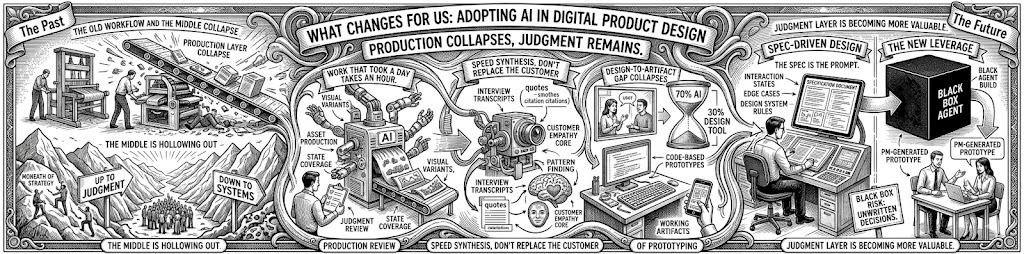
Production is collapsing. Judgment is not.
Three shifts are already visible. The production layer — variants, component states, redlines, design-to-code — is collapsing from days into hours. As generation gets cheap, the bottleneck moves to judgment: the questions asked before generation, the constraints applied to the generator, and the taste to know whether an output is right, wrong, or interestingly wrong.
The middle is hollowing out. The move is to climb up into judgment and user understanding, and down into the systems and code AI generates against. The layer between those two — the part that was mostly pushing pixels — is where the pressure lands hardest.
Three surfaces to start with
Production work is where AI replaces hours, not judgment — the decision about what to make is already done. The test for borderline cases: if you can write down what good looks like before AI generates anything, it's production. If not, the judgment work isn't finished yet.
Research is where AI speeds synthesis without replacing the customer. AI is fast at pulling quotes but slow at understanding what a user was actually trying to accomplish. Every transcript still gets read by a person, and the capacity AI hands back should be reinvested in more direct user contact, not just more output. Speed synthesis — don't replace the customer.
Prototyping is where the gap between "there's an idea" and "someone can use it" shrinks from weeks to hours. The shift to be excited about isn't designers becoming engineers — it's working artifacts getting in front of real users far earlier. Design-to-artifact compression changes what validation looks like.
Where it's heading: spec-driven design
The deeper bet is spec-driven development, where intent is written as a detailed specification, the spec becomes the source of truth, and an agent generates the implementation. "The spec is the prompt." At its extreme, the human never touches the code — which removes the safety net of catching mistakes mid-stream. In that black box, the risk lives in the unwritten decisions an agent quietly resolves on its own.
This is a design problem, not just an engineering one. When generation runs unattended, the only place judgment can live is in the specification, before the build starts. The discipline that makes it work is writing intent as criteria that pass or fail cleanly. "Every cited claim links to its source" is a criterion. "Make it feel trustworthy" is not.
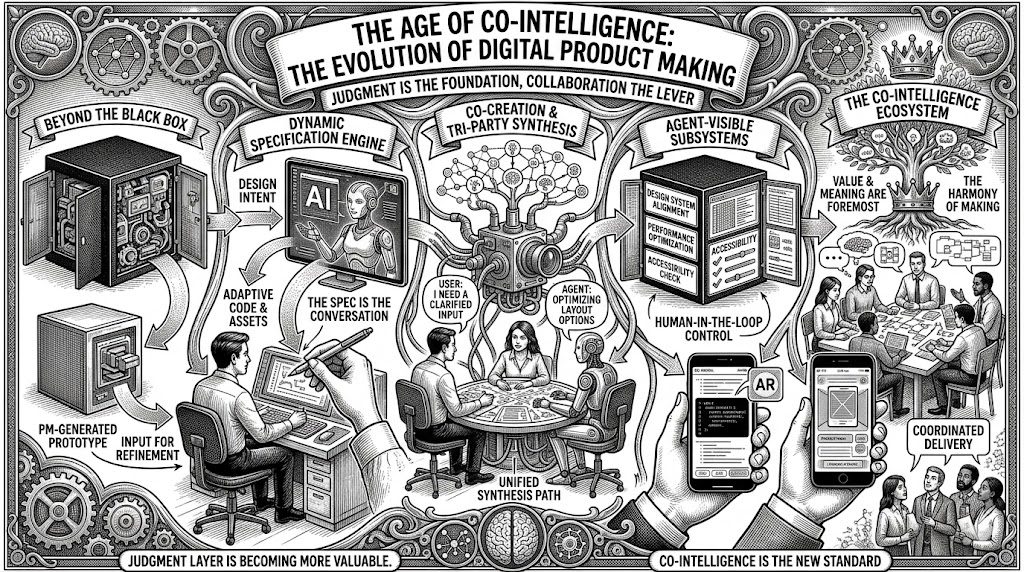
The direction is consistent even if the ground is unsettled: dynamic specification engines, tri-party synthesis between user, designer, and agent, agent-visible subsystems with human-in-the-loop control. The muscle is worth building before the loop closes.
What this asks of you
It's not AI in everything, not a lower quality bar, and not performed adoption — no "look what AI made" screenshots. Usage is not the measure. Throughput, quality, and whether user input shows up in the work are the measures.
The recommended first move: pick one project, move one piece into an AI tool where you already feel friction, then expand to one adjacent task. Expand from friction, not from novelty.
The honest framing
Past waves — web, mobile, design systems, research ops — each took something with it, and this one will too. Some losses will be worth it; some won't. But the instinct to wait until the picture clears worked in past transitions and won't work here, because the picture keeps moving week by week.
What quality means, what a good review looks like, how design and PM and engineering divide work when each can produce what the others used to — none of it is settled. The team that engages now is the team that decides.
Written by a human. Edited with AI.