TL;DR
The design leader's role isn't disappearing, it's evolving into something far more consequential. Strategic Intent Orchestration is the discipline of aligning AI capabilities, business objectives, and human needs into coherent systems of outcome. The designers who master this will define the next era of product leadership. The rest will be automated.
I. The Death of the Artifact
Let's stop pretending. The debate about whether AI will replace designers is over. It already has, at the production layer. Wireframes, visual comps, icon sets, responsive layouts: these are solved problems now. Any team still measuring design value in pixels delivered is running a dead playbook.
The artifact, the mockup, the prototype, the pixel-perfect comp, was once the primary unit of design value. It was how designers proved their worth, how stakeholders measured progress, and how teams communicated intent. That era is over.
AI doesn't just accelerate artifact production. It collapses the distance between idea and output so completely that the artifact itself loses its signaling power. When anyone can generate a polished interface in seconds, the interface is no longer the differentiator. The thinking behind it is.
But here's what the doomsayers miss: the displacement of production design isn't the end of the story. It's the inciting incident. The real question isn't what happens to designers. It's what emerges in the vacuum.
The answer is Strategic Intent Orchestration.
II. Strategic Intent Orchestration
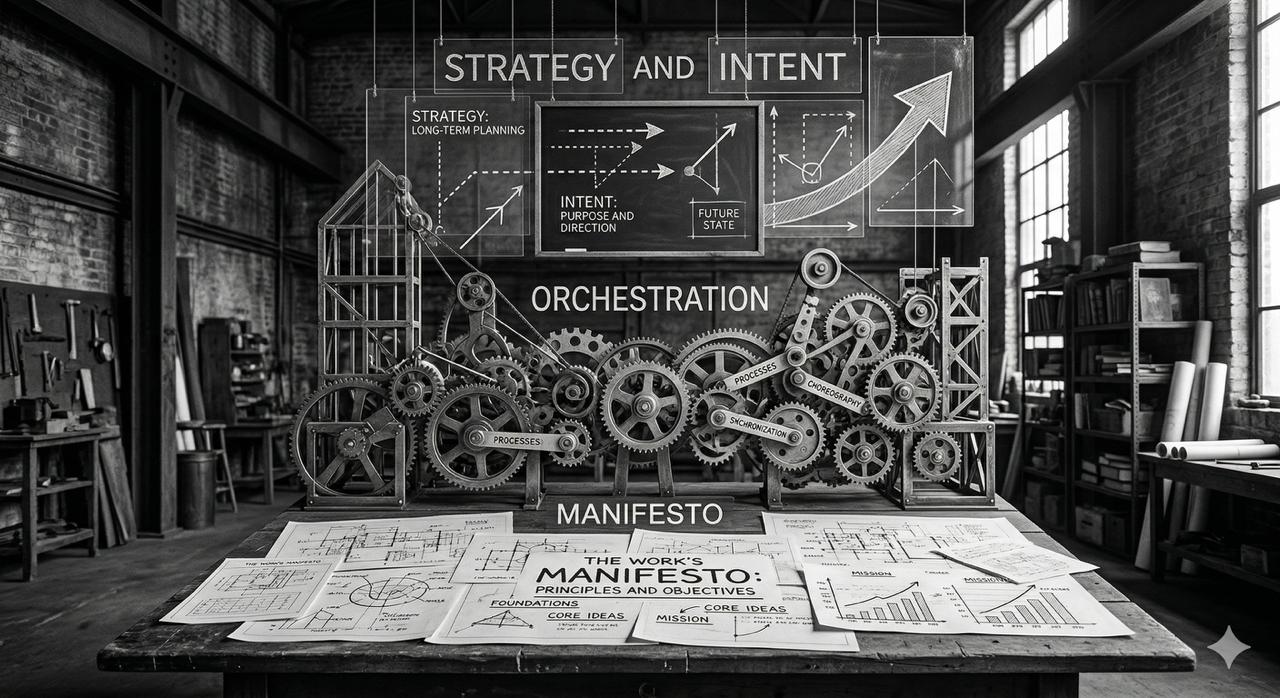
Strategic Intent Orchestration (SIO) is the practice of translating organizational ambition into coordinated systems of human experience, using AI not as a tool, but as a medium.
The word design has been colonized. It now means too many things to too many people, aesthetics, research, systems thinking, facilitation, prototyping, brand, content. That breadth was once a strength. Now it's a liability. When everything is design, nothing is.
Orchestration is a more honest word for what the work actually demands. An orchestrator doesn't play every instrument. They ensure that every instrument serves the composition. They hold the score, the strategic intent, and make real-time decisions about dynamics, tempo, and emphasis as conditions change.
In practice, this means:
- Defining the intent architecture, the explicit map of what an organization is trying to achieve and why, structured so that every team can align autonomously.
- Shaping AI behavior envelopes, the boundaries within which intelligent systems operate, ensuring they amplify strategic intent rather than drift from it.
- Designing feedback topologies, the systems through which outcomes flow back to decision-makers, closing the loop between intent and impact.
III. The Three Pillars
SIO operates at the intersection of three forces. The orchestrator's job is to hold all three in tension, not to optimize for any single axis, but to find the configuration where all three compound.
Business Intent
What the organization needs to achieve, expressed as measurable outcomes rather than feature requests. Revenue models, unit economics, competitive dynamics, organizational incentives, these are now core competencies, not adjacent knowledge. You cannot orchestrate intent you don't understand.
Human Context
The real conditions under which people encounter, adopt, and depend on a product, their constraints, motivations, and the jobs they're hiring the product to do. This is not user research as checkbox. It is the continuous, high-resolution understanding of the humans your system serves.
AI Capability
The expanding frontier of what intelligent systems can perceive, generate, decide, and adapt in real time. Not prompt engineering as a party trick, but a deep intuition for how intelligent systems behave, fail, and compound. Understanding model capabilities, data requirements, and the real boundaries of automation.
IV. The Principles
Intent Over Artifact
The deliverable is not the design. The deliverable is the outcome. Every artifact, every screen, flow, interaction, prompt, or system behavior, exists only to carry intent forward. If you can achieve the outcome without the artifact, do it. The fastest path to value wins.
Systems Over Screens
Products are no longer a collection of pages. They are living systems of interconnected AI agents, data flows, and human touchpoints. The orchestrator's canvas is the system, not the interface. Interfaces are just the visible edge of a much deeper architecture of decisions.
Tempo Over Perfection
In an AI-accelerated environment, the cost of delay exceeds the cost of imperfection. The orchestrator optimizes for learning velocity, shipping coherent intent into the world and adapting based on what comes back. Perfection is a trap. Momentum is a strategy.
Leverage Over Labor
The most valuable contribution is never the work itself, it's the multiplication of everyone else's work. One well-framed problem statement that aligns three teams is worth more than a hundred polished screens. The orchestrator seeks maximum leverage: the smallest intervention that creates the largest shift in trajectory.
Coherence Over Consensus
Consensus is expensive and slow. Coherence is the alternative: a shared understanding of intent that allows autonomous actors, both human and AI, to make aligned decisions without constant coordination. The orchestrator builds coherence through clarity of intent, not through meetings.
V. The Meta-Designer
Strategic Intent Orchestration is not a rebrand of what designers already do. It is the emergence of a new role: the Meta-Designer.
The Meta-Designer doesn't design products. They design the conditions under which products emerge correctly. They operate one level above the work, shaping the systems, constraints, and intent that guide both human teams and AI agents toward coherent outcomes.
This demands new muscles:
- Fluency in business mechanics. Revenue models, unit economics, competitive dynamics, organizational incentives, because you cannot orchestrate intent you don't understand.
- AI-native thinking. Deep intuition for how intelligent systems behave, fail, and compound, not as tools to be prompted, but as collaborators to be directed.
- Comfort with ambiguity at scale. Operating in the space where the problem isn't yet well-defined, the solution space is unbounded, and the stakes are organizational.
- Political fluency. Strategy doesn't execute itself. It moves through people, executives, engineers, product managers, data scientists, each with their own incentives and constraints.
The Meta-Designer is not a manager. They are a force multiplier, the person in the room who ensures that every decision, every sprint, every AI integration serves the strategic intent rather than drifting from it.
VI. The Call to Action
We are not decorators. We are not pixel-pushers. We are not facilitators of someone else's vision.
We are the ones who hold the intent.
In a world drowning in AI-generated output, the scarcest resource is not creation, it's direction. Not what to build, but why to build it, for whom, and to what end. That is the work. That is where the leverage lives.
We orchestrate strategic intent across every surface, system, and stakeholder. We ensure that intelligent systems serve human outcomes, not the other way around. We hold the line between what technology can do and what it should do.
This is not the death of design. This is its most consequential evolution.
The future belongs to the orchestrators.
Written by AI. Orchestrated by a Human.