TL;DR
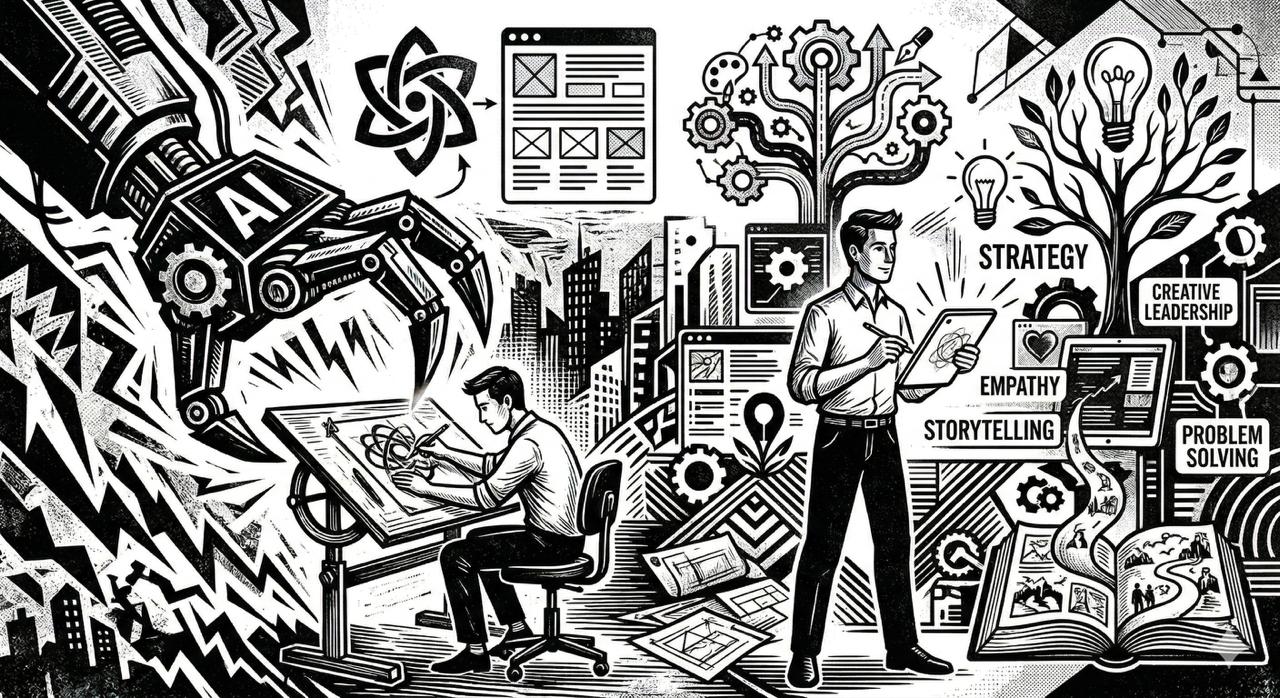
AI is about to make a lot of conventional design production skills irrelevant. The designers who'll thrive are the ones doubling down on taste, curiosity, and frameworks for thinking about fundamentally new kinds of interactions.
Let's Be Honest About Where We Are
Right now, the designers getting hired, especially at the senior and lead level, are the ones who ship. They've got the portfolios, the platform fluency, the track record of output. And that's been the right bet for companies to make. Until now.
The Part Nobody Wants to Hear
Within the next couple of years, generative AI is going to replicate most production-level design work. Not all of it. Not perfectly. But well enough that the gap between "AI-generated" and "designer-produced" shrinks to the point where speed wins. The technical skills that got a lot of us our jobs? They're becoming table stakes at best, commodity at worst.
I'm not saying this from the sidelines. I'm actively building an AI-first product as essentially a one-person operation, directing AI agents the way I used to direct a design team. It works. That should tell you something.
Three Things That Will Actually Matter
1. Taste Is the Moat
Color theory. Typography. Grid systems. Gestalt principles. The Swiss Style didn't become timeless by accident, it works because it's grounded in principles that predate any tool. Designers who internalize these fundamentals become the arbiters of quality, not the producers of it. Your job shifts from making the thing to knowing whether the thing is good. That's a harder skill than most people realize.
2. Research Is Your Superpower
If you don't understand the person you're designing for, it doesn't matter how polished your output is. User research, real research, not just usability testing, is what separates designs that solve problems from designs that just look like they do. Understanding pain points, identifying where value actually lives, connecting design decisions to business impact, AI can't do that for you. It can help you move faster once you know where to point it, but the pointing? That's you.
3. Learn How AI Changes the Interaction Model
This is the one most designers are sleeping on. AI doesn't just speed up existing workflows, it fundamentally changes how people interact with products. Conversational interfaces, multimodal inputs, iterative and adaptive experiences, these aren't edge cases anymore. They're becoming the primary interaction patterns. Design thinking frameworks are how you make sense of this and stitch disparate AI capabilities into something that actually feels cohesive.
The Bottom Line
The designers who stay relevant are the ones who can taste-make, research, and think in systems. The tools are changing. The craft underneath them isn't. If you've been coasting on platform proficiency, now's the time to go deeper. If you've always cared about the why behind the work, you're already ahead.
Written by a human. Edited with AI.